
Hari Singh Nalwa
Commander-in-Chief of the Khalsa Army under Maharaja Ranjit Singh.

About · Gobindgarh Fort, Amritsar
Forty-three acres in the middle of Amritsar — held in turn by the Bhangi Misl, Maharaja Ranjit Singh, the British and the Indian Army, and closed to the public for most of its life.
01 The fort
Gobindgarh began in the 1760s as a mud fortress raised by Gujjar Singh Bhangi, a chieftain of the Bhangi Misl. It was known then as Bhagian da Qila, and it stayed with that family for close to half a century.
Maharaja Ranjit Singh took the fort in 1809 and renamed it after Guru Gobind Singh. The British took it after the Second Anglo-Sikh War in 1849. The Indian Army garrisoned it from 1947.
For almost its entire existence it was a military post, shut to ordinary people and screened from the city by walls and trees. The Government of India handed it to Punjab in 2006 for conservation, and the gates opened on 10 February 2017.
See what is inside today →
02 Timeline
1760s
Gujjar Singh Bhangi raises a mud fortress on the western approach to Amritsar. It becomes known as Bhagian da Qila.
1805–09
The fort passes from Gurdit Singh Bhangi and his mother Mai Sukhan to Maharaja Ranjit Singh. Repairs and rebuilding run under Fakir Azizuddin, with French officers of the Khalsa army advising. It is renamed Gobindgarh, after Guru Gobind Singh.
1849
After the Second Anglo-Sikh War the fort passes to the British, who hold it — and keep improving its defences — until Independence.
1947
The Indian Army garrisons the fort. It stays a military preserve, and for decades the city has almost no access to it.
1964
Punjab declares the fort a historical monument under the Punjab Ancient and Historical Monuments and Archaeological Sites and Remains Act.
2006
The Government of India transfers vacant possession to the Government of Punjab for protection and conservation.
2017
The fort opens to the public on 10 February 2017, and begins its second life as a museum, a venue and a stage.
03 The take-over
By 1809 the Bhangi misl was short of money. Gurdit Singh was still a minor, ruling Amritsar with his mother, Mai Sukhan. When she demanded tribute from a local trader, Arur Mal, he moved to the territory of a rival misl and invited Ranjit Singh to take the fort instead.
Ranjit Singh asked for the Zamzama — Bhangian di Tope — claiming it as the Sukerchakia share of the spoils from Ahmad Shah Durrani’s defeat in 1765. Mai Sukhan refused. He entered the city through the Ahluwalia gate, and the Bhangis could not hold against his force.
The fort, the cannon and the treasury passed to him. Mai Sukhan and the Bhangi family were granted villages for their upkeep. Ranjit Singh renamed the fort for Guru Gobind Singh and gave it the job it kept for a century: standing between the city and the routes in from the north-west.
Zamzama — “the Taker of Strongholds”. The cannon Ranjit Singh demanded
04 The trio
Commander-in-Chief of the Khalsa Army under Maharaja Ranjit Singh.
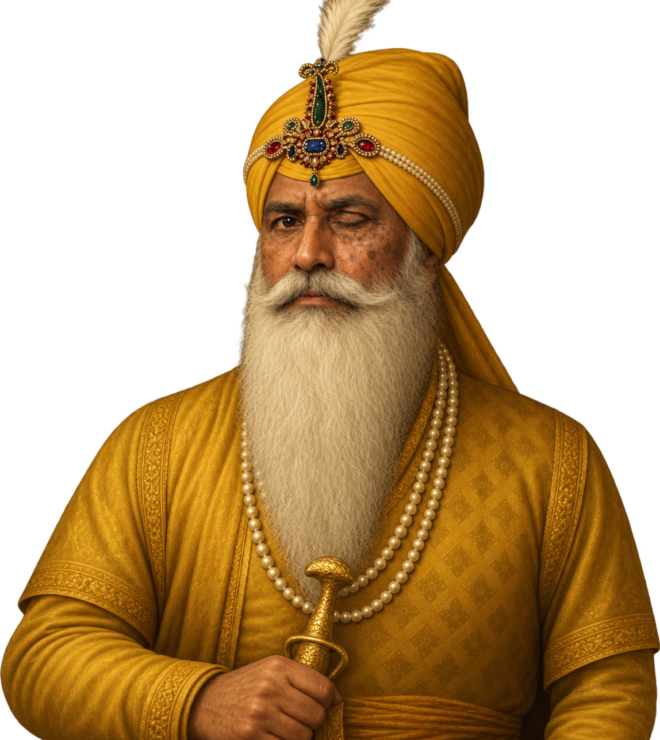
The Lion of Punjab — and the man who gave this fort its name.

Political and military strategist, and Ranjit Singh’s mother-in-law.
Portraits and fort photographs from the fort’s own collection
05 Visit
Entry and the shows are ticketed; the grounds hold the museums, the bazaar, the food street and the darbar hall. Site visits and group bookings are handled by the fort office.
Book ticketsGobindgarh Fort · Amritsar